Exploring Yogic Chai: Answers to Common Queries
Some mornings unfold gently, like the first few notes of a raga, hinting at a day full of possibility. The steam rising from a warm cup of chai intersects with the quiet stillness, inviting contemplation. There is more to chai than what meets the eye. It occupies a unique intersection of Indian contemplative philosophy, authentic cultural history, and the artistry of a perfectly made cup. Today, we dive into this rich tapestry enthusiasts call Yogic Chai, unraveling common queries along the way.
Philosophy & Stillness
In the luminous teachings of Advaita Vedanta, the ultimate realization is: ‘The Self is Brahman.’ It’s a phrase that demands patience, much like the careful brewing of chai leaves. To sit with this understanding requires more than an afternoon. Advaita insists on a profound symmetry between the individual soul and the cosmos, suggesting they are one and the same. Just as chai encourages us to pause and savor the present, this philosophy invites us to meditate deeply on our own nature.
Consider Ramana Maharshi’s practice of self-inquiry. It isn’t merely introspection; it is a disciplined journey inward, aimed at stripping away the layers of ego until what remains is pure consciousness. This mirrors the quiet act of sipping chai, where the warm spices invite a gradual unveiling of layers within ourselves, each sip an echo of ancient wisdom made new.
The Sovereign Self
John Locke once asserted that every person possesses inviolable rights to their own life and liberty. This notion of sovereignty finds an echo in the teachings of Advaita with its perspective of the self as irreducible. It is not political rhetoric but a philosophical foundation. How does one live authentically answerable only to one’s conscience? The ritual of chai consumption can reflect this autonomy. In choosing the ingredients, determining the strength, and deciding when to sit and enjoy the brew, we engage with our own sense of agency.
Traditional Wellness & Ingredients
Each spice in the chai blend has its own story whispered through time. Take ginger, traditionally revered in Ayurveda for its potential to support digestion and bolster immunity. Cardamom, with its sweet aroma, might not just elevate your mood but has also been studied for its role in supporting respiratory health. And then there’s Assam tea, a robust base that carries the medley of spices with elegance, studied for its antioxidants. Yet these aren’t just individual attributes; together, they create a culinary symphony, harmonizing with the mind and body.
Nature & Ritual
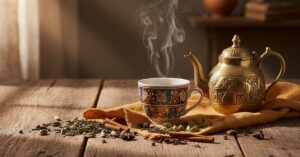
On a crisp morning, wrapped in a shawl, the first sip of chai paints a picture of stillness punctuated by sensation. The warmth flows through your fingertips into your core. Here is where time slows, much like nature’s slow reveal of dawn’s first light. Observing the choreography of flavors, the piquant notes of black pepper harmonizing with cinnamon’s warmth, one learns the power of ritual and the sacred art of taking a pause.
Indian Chai Culture & History
Chai is no mere beverage in India. It is an institution, a conversation starter, a daily anchor. On bustling train platforms, steam rises from cups served by chai wallahs, marking a moment of reprieve amidst life’s rush. The monsoons bring chai’s earthy aromas, intertwined with the scent of wet earth, setting a scene for stories and laughter. Each region weaves its own narrative into the chai experience, reflecting a rich mosaic of tastes and traditions.
Culinary Craft
In the realm of the kitchen, chai transforms from a drink to a creative muse. Imagine a butter cake infused with masala spices, where cardamom’s sharpness finds a perfect complement in vanilla’s mellow notes. Picture a reduction of chai becoming the heart of a sauce, its complex flavors adding depth to a simple dish. This is where chai becomes part of a larger dialogue, not as a gimmick, but as an artisan’s tool, inviting endless exploration.
Yogic Chai isn’t a product; it’s an experience. It calls for slowness, reflection, and care, allowing one to engage both with a historical context and one’s own inner landscape. As we round off our musings with our final sip, let this encounter serve not as a end, but as a doorway to more questions, more reflections, and perhaps, another cup.